 California University of Science and Technology participated in the Education Expo in Damascus.
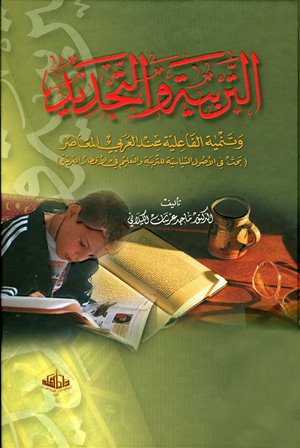
Education, renewal, and developing effectiveness among contemporary Arabs
The provisions for studying the human psyche to discover its patterns, understand its active components and habits, identify its obstacles and detrimental habits—in order to develop the former and protect the human being from the latter—constitute the core of "Educational Jurisprudence." Educational institutions must strive to crystallize, disseminate, and activate this concept. This study aims to contribute to and stimulate interest in this field. Over twelve chapters, it addresses the topic of education, renewal, and the development of effectiveness in the contemporary Muslim.
It sequentially discusses: the meaning and importance of effectiveness; the degree of dependence on others and its associated intellectual and psychological habits; the degree of independence from others and its intellectual and psychological habits; characteristics of the open and closed society; renewal education versus the education of molding, mentality, and administration; modern Arab and Islamic educational systems and the spread of a mindset focused on verbatim repetition and naive consciousness; education, effectiveness, and the hierarchy of human needs; the manipulation of human needs and the stalling of the contemporary Muslim's effectiveness; the patterns of historical transformation and ongoing contradictions in closed societies within Arab and Islamic countries; and the need of Arab and Islamic societies for an educational-renewal movement to transition them from a closed society to an open one.
